
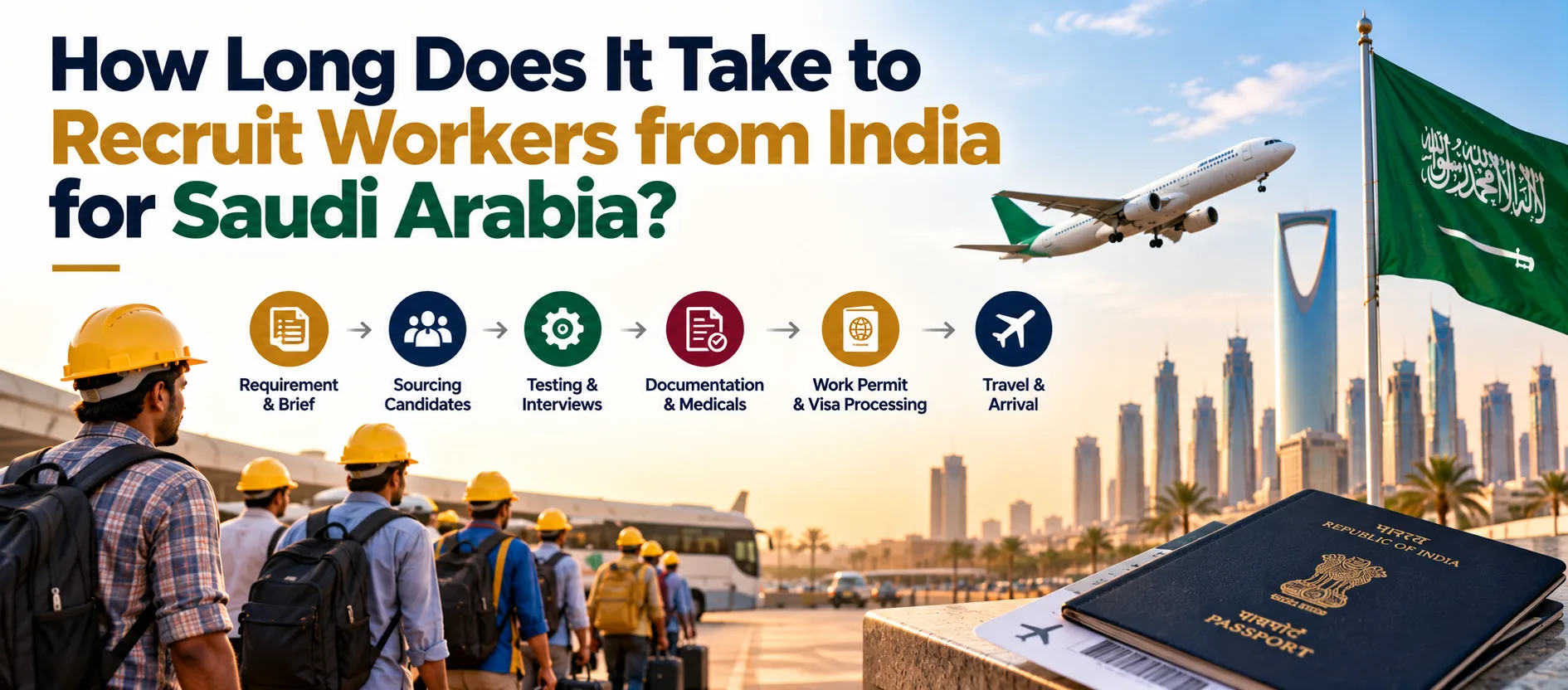
Employers rarely ask this question out of curiosity. They ask because there is a project start date, an opening day or a contract deadline, and people need to be on site before it. So, how long does it take to recruit workers from India for Saudi Arabia? Usually several weeks, and sometimes a few months. The honest version of the answer is that it depends on the trade, the numbers and how well the early stages are handled.
That is not very satisfying on its own, so this guide breaks the timeline into stages, shows where the days tend to disappear and explains how employers plan around it.
The short answer, and why it is never one number
Anyone who quotes you a single figure for every requirement is guessing, or selling. A group of five experienced drivers with clean documents is a different job from sixty workers across six trades.
Think of it like a road trip with checkpoints. The driving itself is short. The time goes at the checkpoints: testing, medicals, permits, travel arrangements. Some checkpoints you control. Some depend on other people, and a few depend on queues nobody can see. A realistic recruitment timeline is the sum of all of them, plus a margin for the one that goes wrong.
We will not quote fixed numbers here, because they would be out of date quickly and wrong for your case. What we can do is show you the stages so you know what to ask for.
Stage by stage: where the time goes
Requirement and brief. This stage is in your hands, and it quietly sets the pace for everything after. A clear brief with roles, numbers, skills, salary and conditions lets sourcing start properly. A vague one leads to a second round of candidates later.
Sourcing. The recruiter searches their network and reaches out to new candidates. Common roles move faster. Rare skills, or very specific experience, take longer to find.
Screening and trade testing. Candidate details are checked against the brief, and skilled roles go through a trade test. Testing takes real time, especially across many trades, but skipping it usually costs more later.
Interviews and selection. If you interview yourself, the speed depends on how quickly you can schedule and decide. Slow decisions lose good candidates, because workers do not wait indefinitely.
Contract and documentation. Contracts are agreed and signed, and documents are collected and checked. A name spelled two ways across documents can add weeks here, so this is a stage worth watching closely.
Medicals. Candidates complete the required medical test. Results can arrive late, and a candidate who does not clear the required checks means a replacement and a restart of part of the process.
Permits and visa-related processing. Non-Saudi workers must meet the applicable conditions and obtain the required work permit before they begin, and the Indian side has its own overseas employment procedures. These stages often depend on paperwork that only the employer can submit, so a signature sitting in someone's inbox can hold up the entire batch.
Travel and arrival. Tickets, flights and pickup arrangements. Short, but not instant, and easy to forget when you are counting days.
What makes it faster or slower
A few things move the timeline more than anything else.
Faster: a written brief, one named person who can approve decisions, common trades, candidates with consistent documents, and a recruiter who tells you early when something is stuck.
Slower: a brief that changes midway, rare or highly specific skills, very large numbers all at once, inconsistent documents, late medicals and slow approvals on the employer's side.
Notice that most of the slow list is about preparation and communication, not luck. That is encouraging, because it means much of the timeline is something you can influence.
How long does it take to recruit workers from India for Saudi Arabia in bulk?
Larger batches rarely take the same time as small ones, because every stage multiplies. More candidates to source, more tests to run, more documents to check, more medicals to schedule.
For bulk hiring, many employers split the requirement into waves. The first wave covers the roles needed earliest. The second wave follows when the programme requires it. This keeps early arrivals productive, and it lets you learn from the first batch before committing to the rest.
It also reduces a quiet risk. When a large group moves through every stage at once, a single bottleneck, a late approval or a batch of medicals, delays everyone together.
Plan backwards from your start date
The most reliable way to use all this is to work backwards. Start with the day you need people productive on site, not the day they land. Subtract the arrival and orientation time. Then subtract travel, permits, medicals, documentation and selection, using the ranges your recruiter gives you. Whatever date you end up with is the latest day you should have shared your requirement.
Then add a margin on top. If that date has already passed, you are not stuck, but you now know to hire in waves, or to move the start date, before the project pays for the gap.
How to shorten the timeline without cutting corners
You cannot remove the checkpoints, but you can shorten the gaps between them.
Write the brief before you contact anyone. Decide who approves candidates and contracts, and tell the recruiter. Agree the trade test standard in advance. Ask candidates to prepare documents early, and ask your recruiter to check them for consistency before anything is submitted. Keep a few spare candidates on the shortlist, since someone almost always drops out. And ask for a progress update at each stage, not just at the end.
What does not work is cutting testing or document checks to save a few days. Those shortcuts tend to return as replacements and rework, and the time lost is usually larger than the time saved.
What a realistic timeline conversation sounds like
When you speak to a recruiter, ask for a range by stage and not a single date. Which stages do you control, and which depend on us? What usually causes delays for requirements like ours? How will you tell us when something slips? What happens to the timeline if a candidate fails a medical?
Picture a restaurant group in Riyadh planning a new branch with a fixed opening date. They work backwards from the opening and count from the day candidates are selected. But the permit paperwork waits on one signatory, two candidates fail medicals and the opening slips by a few weeks. The group did not do anything unusual. They counted from the wrong starting point, and they did not allow for replacements.
Why Maktab Istiqdam Al Hind
We are a recruitment office with more than 15 years of experience recruiting Indian workers for employers in Saudi Arabia and across the Gulf, with teams in Mumbai and New Delhi. We start with your requirement, tell you plainly where delays are likely, and keep you informed as each stage moves. If you have a date to work towards, you can call us on +91 7054899410 and tell us what you need.
Frequently Asked Questions
How long does it take to recruit workers from India for Saudi Arabia?
It usually takes several weeks and can extend to a few months, depending on the trade, the numbers and the processing on both sides. Ask your recruiter for a realistic range by stage and keep a margin in your project plan.
What stage takes the longest?
It varies, but documentation, medicals and permit processing are common sources of delay, especially when documents are inconsistent or approvals wait on one signature. A clear brief and early document checks reduce the risk.
Does hiring in bulk take longer?
Usually, yes, because every stage multiplies. Many employers split large requirements into waves that match their programme, so early arrivals are productive while later groups finish processing.
Can the recruitment process be speeded up?
Often partly. Prepare a clear brief, name one approver, agree testing standards early, check documents for consistency and keep spare candidates. Skipping testing or document checks usually costs more time than it saves.
Do workers need a work permit before travelling to Saudi Arabia?
Non-Saudi workers must meet the applicable Saudi conditions and obtain the required work permit before working. The specific requirements depend on the employer and role, so check them through the official channels.
What happens if a candidate fails the medical?
You will normally need a replacement, which restarts part of the process for that position. Ask your recruiter in advance about the replacement policy and how long it applies.
Final thoughts
Most delays in recruitment are not dramatic. They are small gaps between stages that nobody owned, and a start date that quietly assumed nothing would go wrong. If you plan for the checkpoints and not just the destination, the days tend to behave a lot better.
