
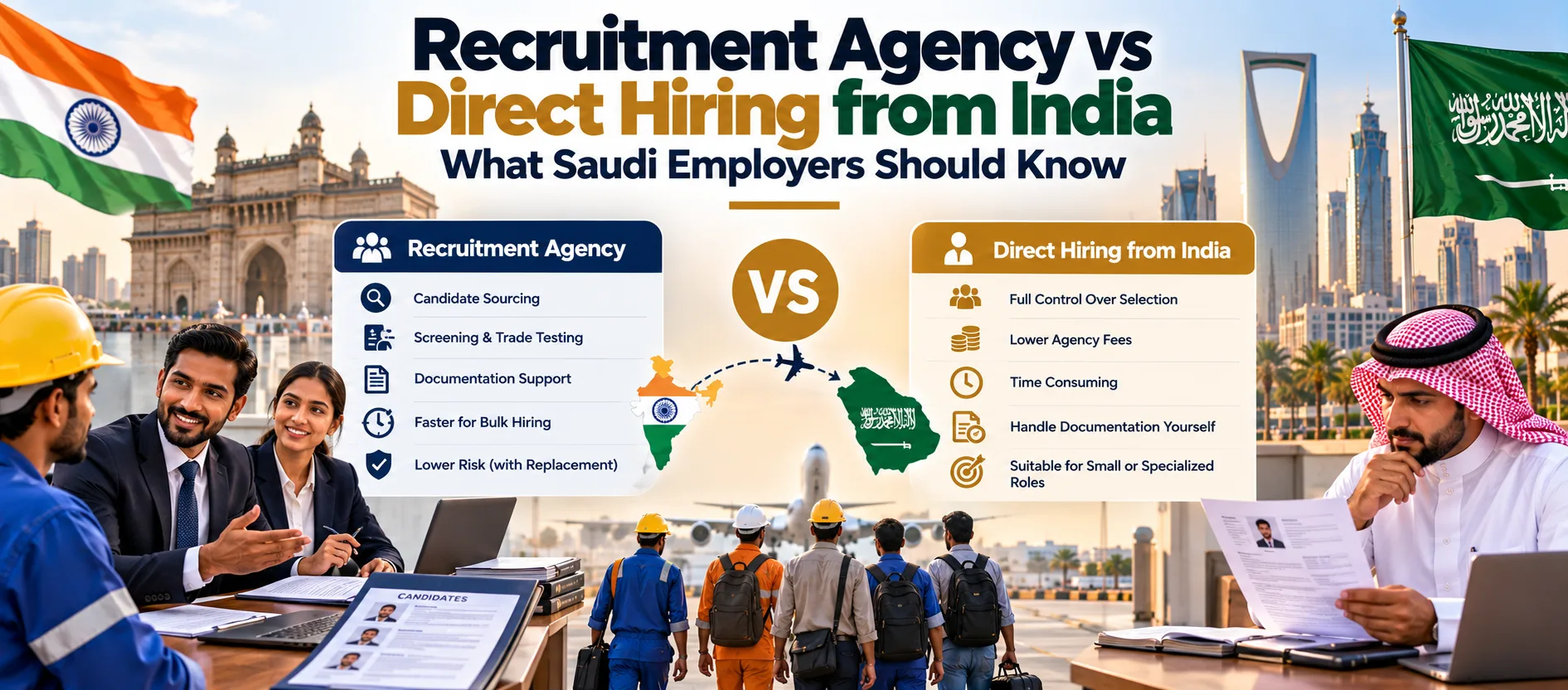
Sooner or later, almost every Saudi employer who hires from India asks the same question. Should we do this ourselves, or hand it to someone who does it every week? It is a fair question, and the honest answer is that it depends on what you are hiring, how many people you need and how much of the groundwork you are willing to own.
We are a recruitment agency, so weigh what follows with that in mind. We will try to be fair about it anyway. The recruitment agency vs direct hiring from India decision is not one where a single option wins every time, and some employers really are better off going direct.
What direct hiring from India actually involves
On paper, direct hiring sounds simple. You find workers, interview them, sign contracts and bring them over. In practice, a few things sit underneath that sentence.
You need a way to find candidates, which means job postings, contacts in India, or a team that can search and shortlist. You need to screen them, and for skilled trades that means testing what people can really do and not only reading certificates. You need to coordinate documents, medicals and permits across two countries. And you need to keep every candidate informed, because workers who hear nothing for weeks tend to drop out.
On the Indian side, foreign employers may recruit through a registered Recruiting Agent, or directly where the applicable requirements for direct recruitment are met. For many worker categories there are emigration procedures to complete as well. The exact steps depend on the category and change over time, so confirm the current position with the Ministry of External Affairs before you plan around it. On the Saudi side, workers must meet the applicable conditions and obtain the required work permit before they start.
None of that is impossible. It is simply work, and it lands on somebody in your company.
What an agency takes off your plate
Think of it like importing goods. You can arrange shipping, customs and delivery yourself, or you can use a freight forwarder who knows the routes and the paperwork. The goods are the same. What changes is how much of your own time the process eats.
A good Saudi Arabia recruitment agency, or an Indian partner working for Saudi employers, typically handles sourcing, screening and trade tests, interview scheduling, contract and document coordination, and progress updates. You still decide who joins your team. The agency does the legwork between your requirement and your final choice.
Recruitment agency vs direct hiring from India: the real differences
Here is how the two compare on the factors that matter most.
Control. Direct hiring gives you the most. You see every CV and speak to every candidate yourself. With an agency you share control, though a good one lets you interview candidates and set the testing standard.
Speed. Direct hiring can be quick for one or two roles if you already have contacts. For larger batches it slows down, because every step is on your team. Agencies usually move faster on volume because the process is already built.
Cost. Direct hiring avoids an agency fee, but it carries costs that rarely show up on a budget line: staff time, travel for interviews, failed candidates and delays. Agency fees are visible and agreed up front. Ask what the fee covers and what it leaves out, since a low fee that excludes screening or documentation is not low at all.
Risk. With direct hiring, every mistake is yours. With an agency, risk is shared if you have a clear replacement policy and a written agreement. But a careless agency adds risk of its own, so check the partner properly.
Paperwork. This is where direct hiring surprises people most. Documents must be consistent and complete across both countries, and a small mismatch can stall a candidate for weeks.
When direct hiring makes sense
Direct hiring tends to work when the requirement is small and repeated, when you already have a reliable network in India, when you have someone in-house who understands the Indian procedures, and when speed is not critical. A company that hires two or three people a year through a trusted contact may not need an agency at all.
It also works when the roles are senior or specialised and you want to be personally involved in every selection.
When an agency is the better fit
An agency usually makes more sense for bulk hiring, for urgent projects with fixed deadlines, for employers new to hiring from India, and for requirements that span several trades at once. It also helps when you do not have staff to spare for sourcing and follow-up, or when you want screening and trade testing handled consistently across a whole batch.
Picture a contractor in Jeddah who tries to fill twenty technician positions through contacts and online postings. The first interviews go well. Then candidates drop out, two certificates turn out not to match the work, and nobody on the team has time to chase documents. Three months in, nine people are on site, and the project manager is spending half his week on recruitment. The fee he avoided is now a smaller number than the time he lost.
Or the opposite: a family business that needs one accountant from India and finds a good candidate through a relative. Going through an agency would have added cost and little else. Neither case is unusual.
The middle path
Many employers end up in between. They use an agency for sourcing, screening and documentation, but make the final selection themselves and stay closely involved in the brief and testing. Others hire directly for senior roles and use an agency for volume.
If you go this way, write down who does what. A split of responsibility that lives only in conversation is where most misunderstandings begin.
Questions to settle before you choose
Ask yourself a few honest questions. How many workers do we need, and by when? Do we have anyone who can handle sourcing, testing and documents without neglecting their real job? Have we done this before, and what went wrong last time? How much control do we want over each selection?
If you choose an agency, ask for their Recruiting Agent registration number and verify it on the eMigrate portal. Ask what the service includes, whether you can interview candidates, what the replacement policy is and how updates will reach you. And ask to speak to an employer they have worked with.
Why Maktab Istiqdam Al Hind
We are a recruitment office with more than 15 years of experience recruiting Indian workers for employers in Saudi Arabia and across the Gulf, with teams in Mumbai and New Delhi. We start with your requirement, evaluate candidates against it, and keep you informed as each stage moves. If you would like to talk through whether an agency makes sense for your requirement, you can call us on +91 7054899410.
Frequently Asked Questions
Can a Saudi employer hire workers from India directly?
Yes, through the applicable channels. Foreign employers may recruit Indian workers through a registered Recruiting Agent or directly where the Indian requirements for direct recruitment are met. Employment in Saudi Arabia must also follow Saudi rules, including the required work permit.
Is direct hiring cheaper than using a recruitment agency?
It avoids an agency fee, but it carries other costs such as staff time, interview travel and delays from failed candidates. For small, repeated hires it can be cheaper. For larger batches the total cost is often closer than it looks.
Is a recruitment agency faster than hiring directly?
For volume, usually yes, because sourcing, screening and documentation follow an established process. For one or two roles with an existing contact, direct hiring can be just as quick.
What should Saudi employers check before choosing an agency in India?
Ask for the Recruiting Agent registration number and verify it on the eMigrate portal. Confirm what the service includes, how candidates are tested, what the replacement policy is, and whether you can speak to a current client.
Can I interview candidates if I use an agency?
You should be able to. Reputable agencies arrange in-person or video interviews and trade tests on request, and many welcome your involvement.
Can I combine direct hiring and an agency?
Yes. Many employers hire senior or specialised roles directly and use an agency for volume or for sourcing and documentation, while keeping final selection in their own hands. Agree in writing who handles which step.
Final thoughts
The better question is rarely which option is cheaper on paper. It is which one leaves your project with the right people, on a date you can plan around, without your best manager spending half his week on paperwork. Answer that honestly, and the choice usually makes itself.
